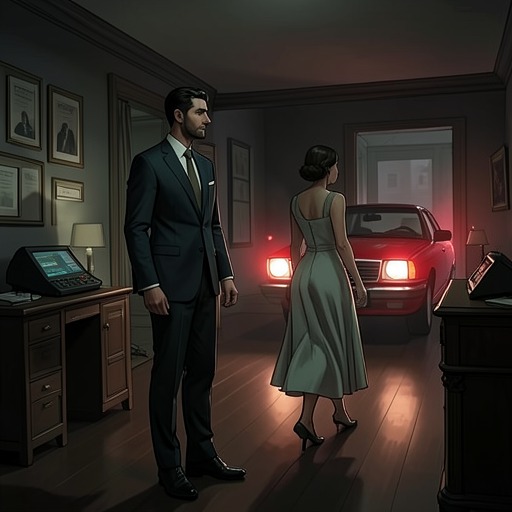
General Sternwood hires Philip Marlowe to investigate Arthur Geiger
The Big SleepGeneral Guy Sternwood hires Philip Marlowe to investigate Arthur Geiger after a blackmail threat revives the family’s earlier dealings with Joe Brody. What begins as a discreet inquiry into Geiger’s claim leads Marlowe into a sequence of murder, concealment, and institutional compromise, while his obligation to protect his client becomes a central obstacle to the public record of what happened.
The Commission
The assignment arises during Marlowe’s visit to Sternwood estate, where the General explains that Terence Regan, who had been a source of companionship to him, left abruptly about a month earlier. The departure has hurt the General, but his immediate concern is a new blackmail attempt. He says that before Regan arrived, he paid Joe Brody five thousand dollars to leave Carmen Sternwood alone. The payment establishes that the threat against the family is not new, even though the current demand comes from a different man.
The General hands Marlowe a brown envelope addressed to him. Inside are Arthur Gwynn Geiger’s card, identifying a rare-books business, and three promissory notes signed by Carmen Sternwood. Each note promises Geiger one thousand dollars. Geiger’s accompanying letter characterizes the notes as gambling debts but suggests the General may wish to honor them despite their legal uncollectibility. The papers give Marlowe a concrete starting point: Geiger has a financial claim tied directly to Carmen, and the General wants the matter investigated rather than simply paying without knowing what he is buying.
Marlowe offers to take Geiger off the General’s back, while warning that resolving the pressure may cost additional money and may not produce anything for the family. His distinction is practical: paying could be cheaper and easier than pursuing the matter, but would not necessarily end the blackmail. The commission therefore begins not as a promise of a clean legal remedy but as an inquiry into how much leverage Geiger possesses and what it will take to contain it.
From Inquiry to Deaths
The investigation quickly exceeds the apparent dispute over Carmen’s notes. Marlowe watches Geiger’s house during a rainstorm and sees a car registered to Carmen arrive. At seven-twenty a flash of light comes from the house, followed by a scream; as Marlowe approaches, he hears three shots, then footsteps and a car departing. When he returns later, Geiger’s body has disappeared. The missing body and the signs that the room has been altered turn the assignment into an investigation of a killing and its concealment, rather than a simple blackmail negotiation.
The crimes widen further when Owen Taylor, the Sternwoods’ chauffeur, is found dead in a car recovered from the Pacific Ocean off Lido Pier. Bernie Ohls explains to Captain Cronjager that Taylor was the chauffeur of a family being blackmailed over one of its daughters, and that Taggart Wilde had recommended Marlowe to the family through him. The connection makes clear that the General’s request has drawn Marlowe into events involving not only Geiger’s pressure but also the chauffeur’s death and the police response.
The investigation also intersects with the older disappearance that troubles the General. Captain Gregory tells Marlowe that Terence Regan disappeared on September 16. The chauffeur was off that day, and nobody saw Regan take his car. Four days later the car was found in a garage at Casa de Oro, a bungalow court near Sunset Towers. Police found no identifiable fingerprints, and Gregory describes the circumstances as compatible with one explanation while also leaving reason to suspect foul play. The unresolved car and the uncertainty surrounding Regan’s disappearance extend the original commission beyond Geiger and make the General’s family history part of the same investigative landscape.
Marlowe’s Loyalty and Its Cost
Marlowe’s handling of the case is shaped by his decision to protect his client. In his account to Ohls, Wilde, and Cronjager, he says he told the rest of the story as it happened but omitted Carmen’s visit to Joe Brody’s apartment and Eddie Mars’s visit to Geiger’s house. Cronjager challenges the consequences of this secrecy: because Marlowe did not report Geiger’s murder that night, the books could be moved from Geiger’s store to Brody’s apartment, and Carol Lundgren was subsequently led to Brody and killed him. Marlowe acknowledges that he may have done wrong, explaining that he wanted to protect his client and did not expect Lundgren to go after Brody.
The conflict is not merely personal. Marlowe argues that Geiger’s store was a front for an illicit business and that the Hollywood police had allowed it to operate for their own reasons. He offers to testify that one of the books came from the store and says Agnes Lozelle will confirm the nature of its business. The possibility that a grand jury might ask why the operation was tolerated gives the police a reason to prefer a limited, manageable account. Cronjager admits that public exposure would not help his division, making the official handling of the case a negotiation over which facts will be reported, not simply a search for the full sequence of events.
Official Account and Larger Significance
The next morning’s newspapers present a version that, in Marlowe’s judgment, is far from the truth. They do not connect Owen Taylor with the killing at Geiger’s house, and they omit the Sternwoods, Ohls, and Marlowe. Instead, they describe Taylor as a wealthy family’s chauffeur, credit Cronjager with solving two killings connected to a dispute over a wire-service business, and report that Brody killed Geiger while Lundgren killed Brody in revenge. Lundgren is in custody and has confessed; Agnes is held as a material witness. The papers also characterize Taylor as despondent and in poor health, and report that there will be no inquest.
The commission’s consequences reach beyond the immediate deaths. Marlowe’s client-protecting omissions help shape the route by which evidence moves and leave the police free to publish an account that excludes key connections. The discrepancy between the investigation and the newspaper story makes the General’s hiring of Marlowe an entry point into the novel’s concern with compromised authority: private loyalty, police convenience, and the desire to suppress scandal all help determine what becomes publicly knowable.
That tension persists when Captain Gregory describes himself as an ordinarily honest policeman who would like to see powerful offenders punished, but doubts that justice works that way in Los Angeles or elsewhere. He says Eddie Mars admitted concealing his wife at Realito and using Lash Canino as a protection man, while denying knowledge of Canino’s other activities or of the murders. The account does not resolve every question about the wider criminal network. Nor does Marlowe’s eventual disclosure to Vivian Regan of the truth about Carmen’s murder of Regan turn the original assignment into a public reckoning. Instead, Marlowe leaves the General protected from that knowledge, reflecting that the old man will soon be sleeping the big sleep. The hire thus ends in a morally uneasy form of service: Marlowe has pursued the truth, but not every truth is delivered to the client, the police, or the public.